
The Airport Infrastructure Blueprints

Airside Area
1.Runway
Two instrument runways. The 05L/23R runway (i.e., the north runway) measures 3,660 meters and the 05R/23L runway (i.e., the south runway) measures 3,800 meters. Both are 60 meters in width with a central spacing of 1,506 meters. The officially publicized dual-runway capacity is 50 aircrafts per hour.
2.Taxiway
For the taxiway system allocation, the taxiway width is over 30 meters.
3.Apron
There are currently a total of 86 operating aprons and 30 maintenance aprons.

Passenger Terminals
1.Terminal 1
It has a floor space of 186,671 square meters with an annual passenger service capacity of 15 million.
2.Terminal 2
With a floor space of 351,017 square meters, including the T2 expansion project which has been completed with its passenger service capacity up to 22 MPPA (million passengers per annum).

Cargo Area
There are 4 air cargo terminals with an annual cargo handling capacity of 2.9 million metric tons.

Utilities
1.Maintenance Hangars
7 maintenance hangars in total.
2.Other Facilities
Including fuel transmission and distribution system, fire and rescue stations, catering facilities, main substations, pump stations, wastewater treatment facilities, waste treatment facilities, and ground service equipment maintenance area, etc.
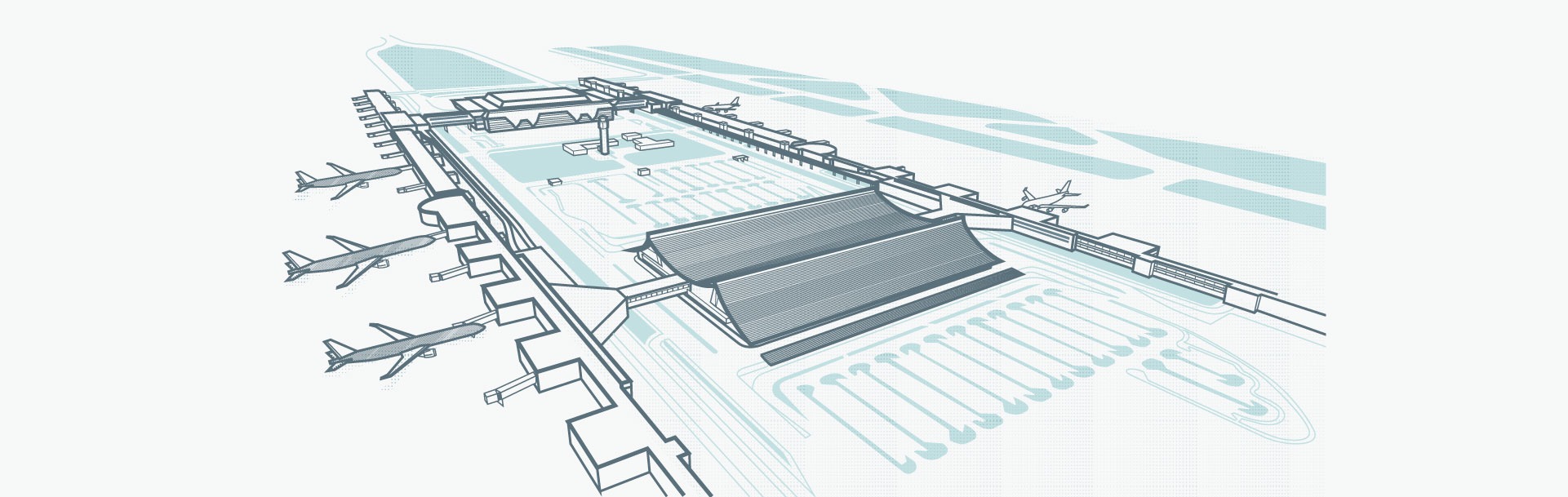
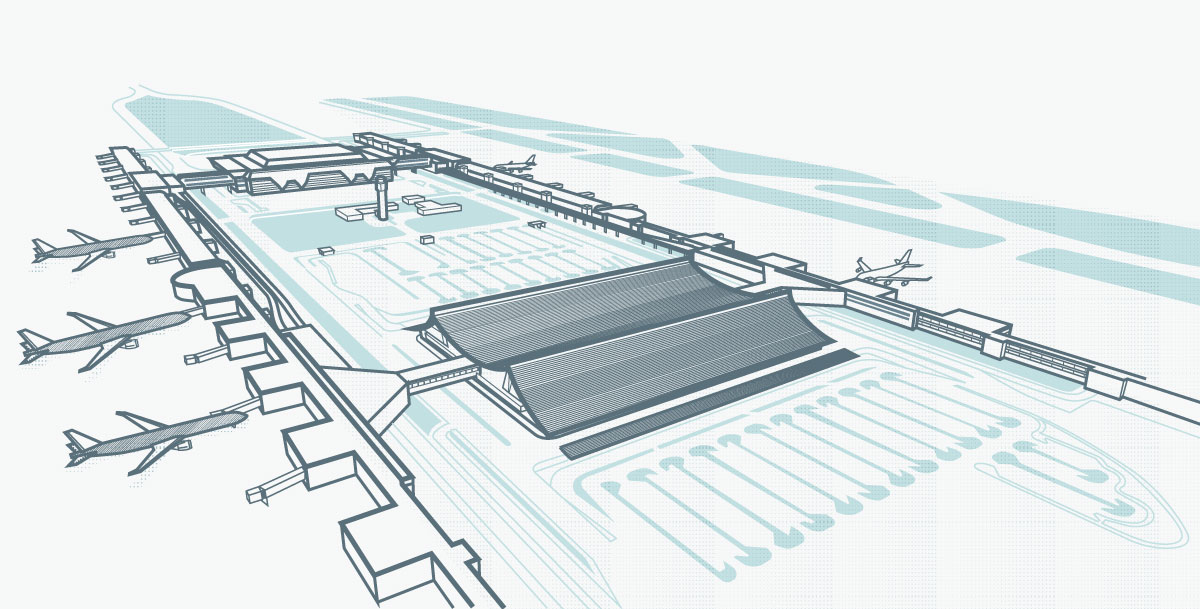
Airport Zone
1. Terminal 3
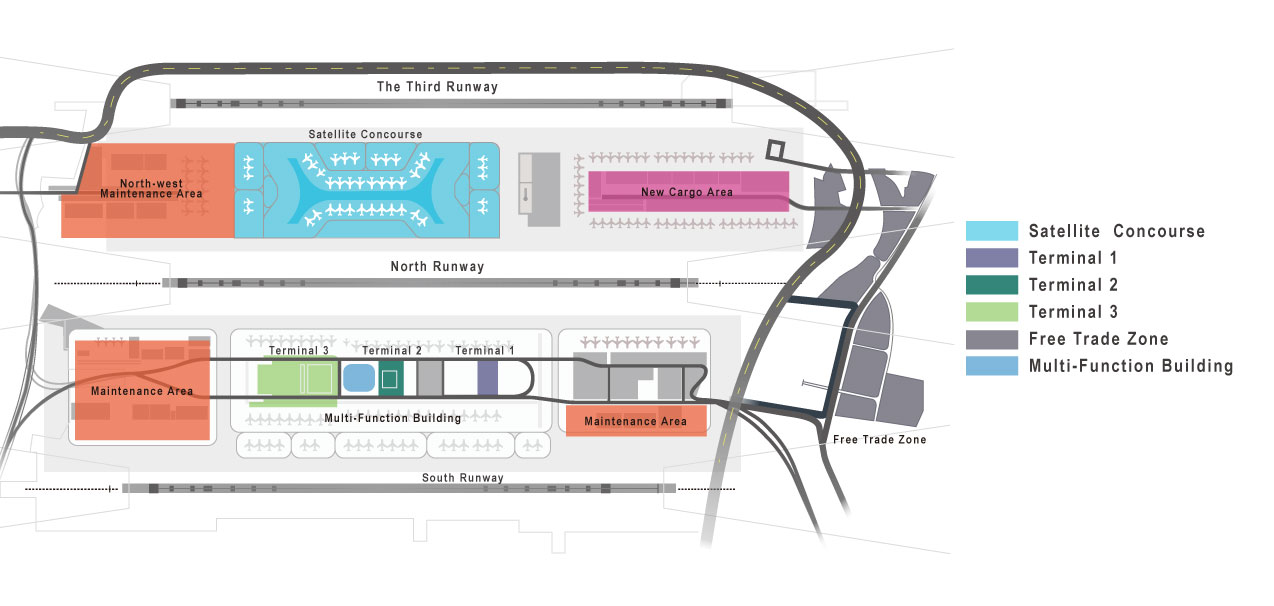
Planned as a Mega Terminal, it integrates into multi-purpose buildings for tourism, shopping, culture and art. In future, TTIA will target Terminal 3 as its principal terminal with an annual passenger capacity of 45 million and MFB will provide connection between Terminal 2 and Terminal 3, it integrates energy-saving low-carbon green buildings covering a floor space of 550,000 m².
2. Multi-Function Building Development Zone (MFB)
As a city center of the Taoyuan Aerotropolis, including transportation, commercial, office, art, tourism, and shopping functions.
3. Runway/Taxiway Allocation
The plan is to build a 3rd runway on the north side measuring 4,000 meters in length, with a spacing of 1,295 meters from the north runway.
Regarding taxiways, a set of two vertical access taxiways are planned for both the east and west side of the satellite concourse. On the land of existing area, there are construction projects, such as WC taxiway relocation and expansion, NP taxiway extension, parallel taxiway on the north side of the north runway, 05L end-around taxiway, and EC taxiway expansion.
4. Apron Planning
After reviewing the trend of air traffic growth and the aviation market, the number of aircraft stands in 2042 can meet the demand of 177 passenger aprons, sufficiently satisfying the apron demands of all types of aircrafts.
5. Passenger Terminal Planning (Introducing smart facilities)
After Terminal 1 expansion completed in 2013, T1 capacity has increased to 15 MPPA. After T2 expansion completed in 2019, T2 capacity has been increase to 22 MPPA. After new Terminal 3 and satellite concourses construction are finished, T3 will provide a service capacity of 45 million passengers.
6. New Cargo Area
The land area is approx. 33 ha., with a cargo apron capacity of no less than 42 cargo aprons to meet the long-term demand. The new cargo area will include such facilities as cargo terminals, airmail center, back-up support, and administration offices.
7. North-West Maintenance Area
The land area is approx. 70 ha for remote aprons, taxiways and taxi lanes, auxiliary service support (e.g. ground service equipment maintenance area, waste water handling plant), service roads, strategic reserve land, office space, hangars, and maintenance aprons.
8. North Satellite Concourse
On a land of approx. 104 ha (excluding reservation land); target capacity: 25 MPPA.
Expected land use plan results for the entire airport layout is as indicated in the image.
Expansion of FTZ
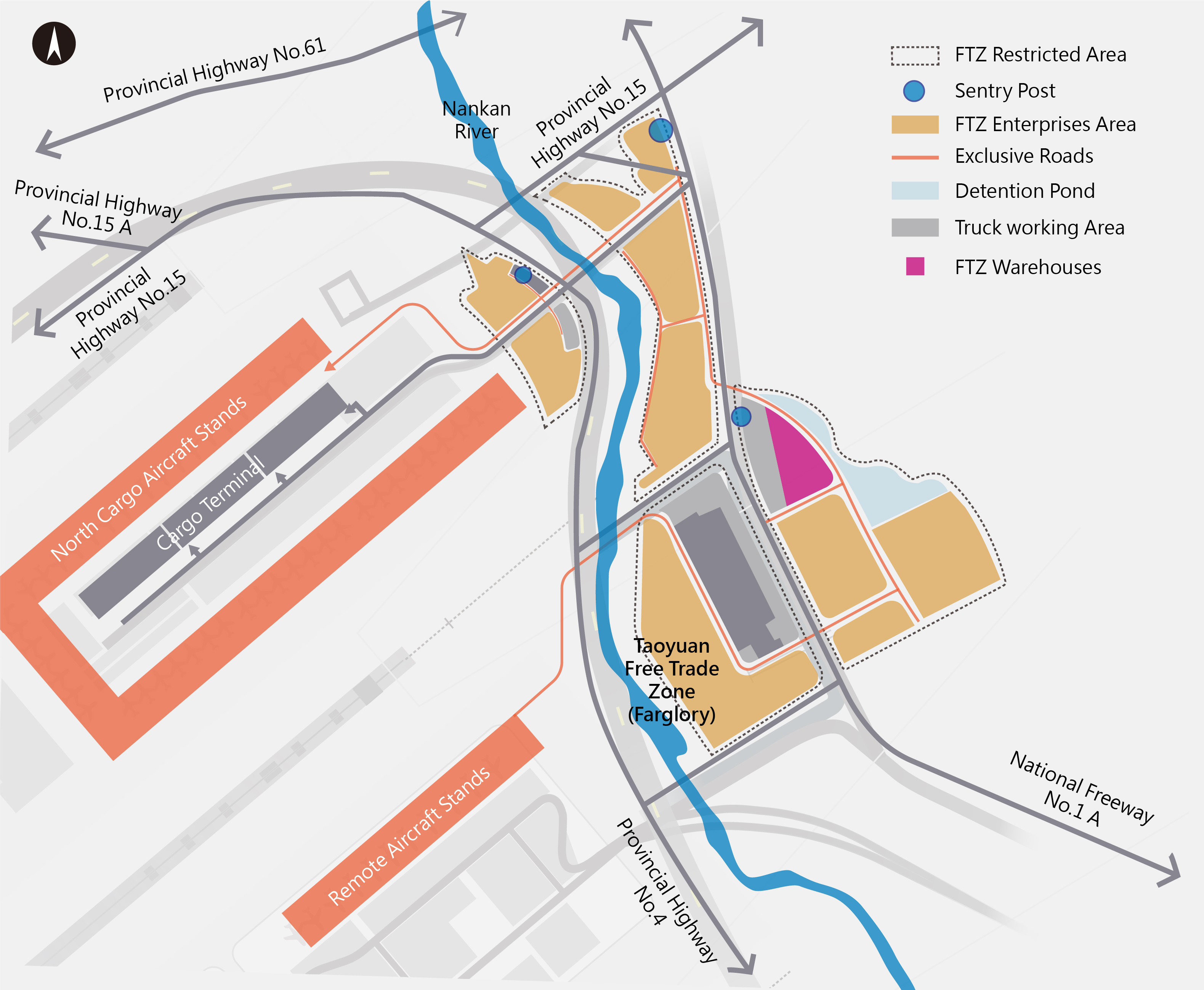
The facilities of Taoyuan International Airport Free Trade Zone (FTZ)include air cargo terminal, domestic and international logistics zone, value-added zone, business (operation) center on a planned land expansion of 74 ha.The development is to head towards the three major strategies: "logistics-oriented," "simple value-added processing" and "extension services." For the overall development positioning, “Asia-Pacific Creative Value Hub Leads Taiwan's Free Economy” is proposed. For its function positioning, the following three principles are proposed:
1.Export Taiwan's advanced technologies and services:
Develop manufacturing optimization service; Make good use of Taiwan's manufacturing industry's core technologies and components; Combine operation management; Integrate products’ after-sales service procedures; Maximize value-added effectiveness.
2.Promote innovation of industry development models:
Bring in international logistics operations industries; Expand residency in the free trade zone; Boost innovation of industry development models.
3.Link supply chains for emerging industries:
Enhance the export production output of Taiwan's emerging industries; Combine industry core technologies and airport logistics operation advantages; Connect Taiwan's industries and emerging industries across the globe.
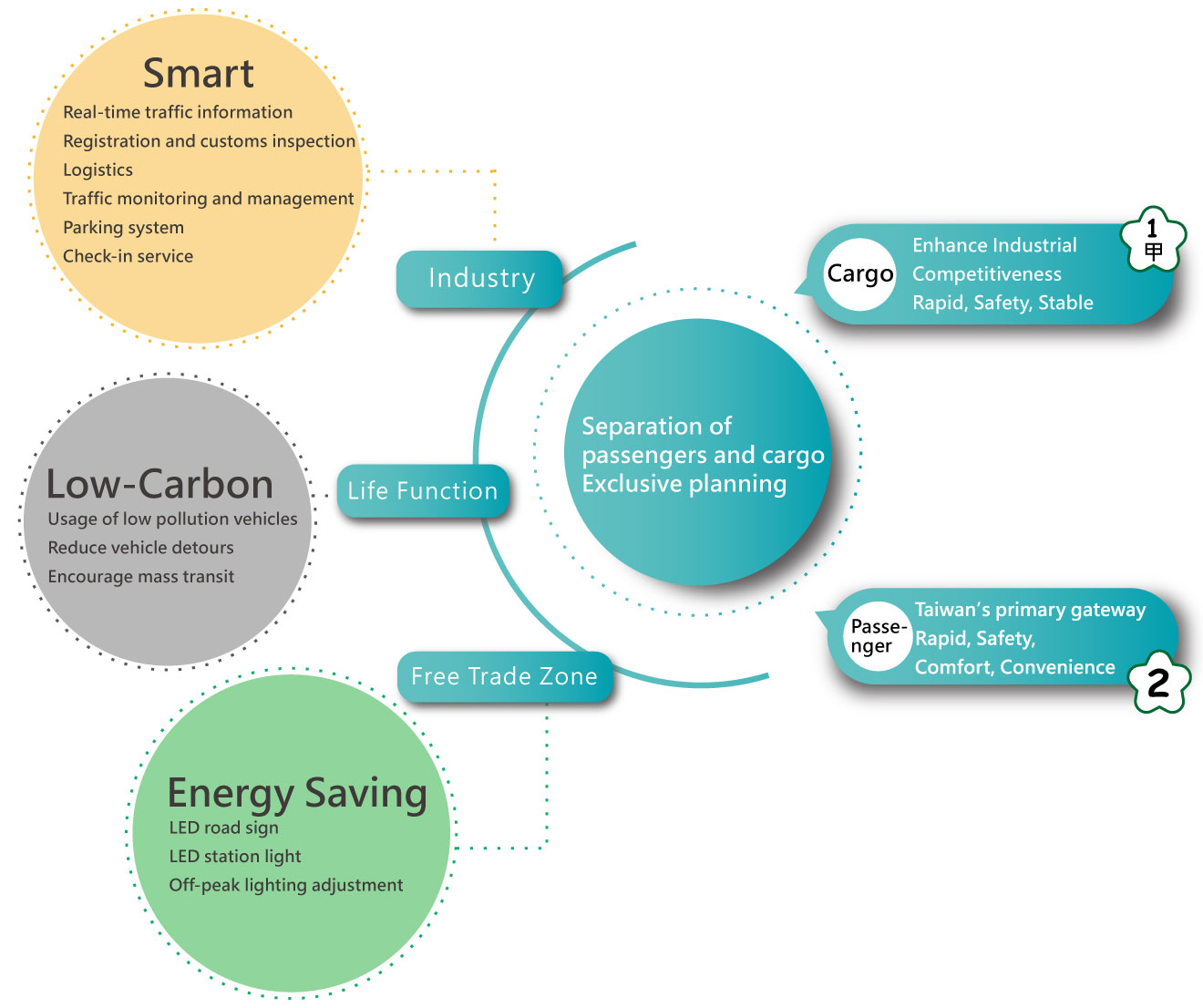
TTIA is Taiwan's primary gateway. Transportation for cargoes and passengers will be separated based on their special needs, bringing in smart, low-carbon and energy-saving transportation system in line with the airport's goal towards a green, sustainable and smart development.
The ground access aims to achieve convenient and smooth connection between the airport and its surrounding aerotropolis. Comprehensive express highway system and an airport MRT will get you to Taipei City in 40 minutes. In addition, a connecting High Speed Rail will get you to all major cities on the west coast of Taiwan in 90 minutes. Neighboring Taipei Harbor, an express highway also offers convenient joint sea/air transportation to satisfy all cargo/passenger demands.
Airport Access Transportation System
The future access transportation system of TTIA is shown in the image below. It will connect the National Freeway No.2, National Freeway No.2 A, National Freeway No.1 A, Provincial Highway No.15 and Provincial Highway No.61.
Besides, with the traffic demand of New Cargo Area and North West Maintenance Area, and the insufficient capacity of Dayuan Interchange on National Freeway No.2, the proposed improvement strategies are as follows:
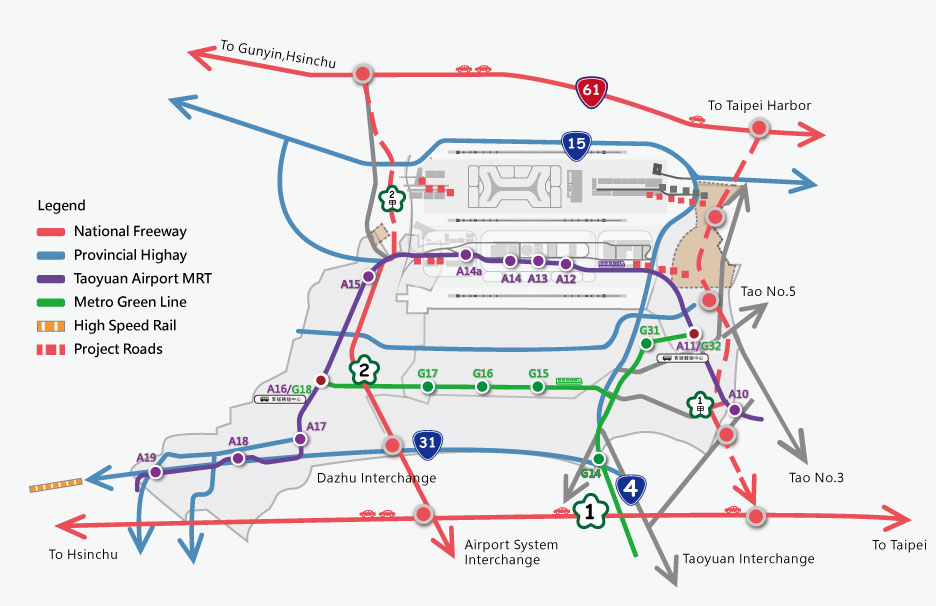
Adding an access road of the New Cargo Area.
Adding an access road of the North-west Maintenance Area to directly connect with the Provincial Highway No. 15.
Road Traffic Improvements Within The Airport Park
Ground Transportation Center (GTC)
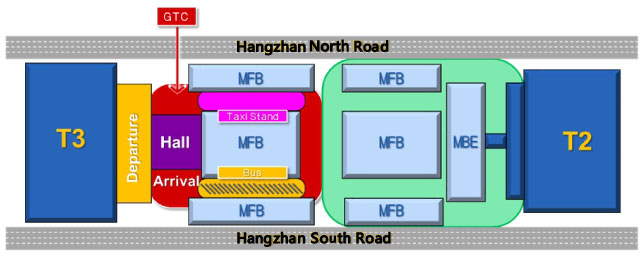
Through the establishment of a GTC, the integration of multi-transportation mode will be integrated to achieve the purpose of concentrating mass transportation and scheduling facilities. In preliminary planning, the location is between the T3 and T2 (the current P4 area), and the structure will be integrated with the Multi-function Building (MFB). The facilities requirements and configuration are shown in the image. The traffic flow follows the concept of foot traffic and vehicle traffic separation in cooperation with the terminal floor plan on both sides.
The Overall Transportation System
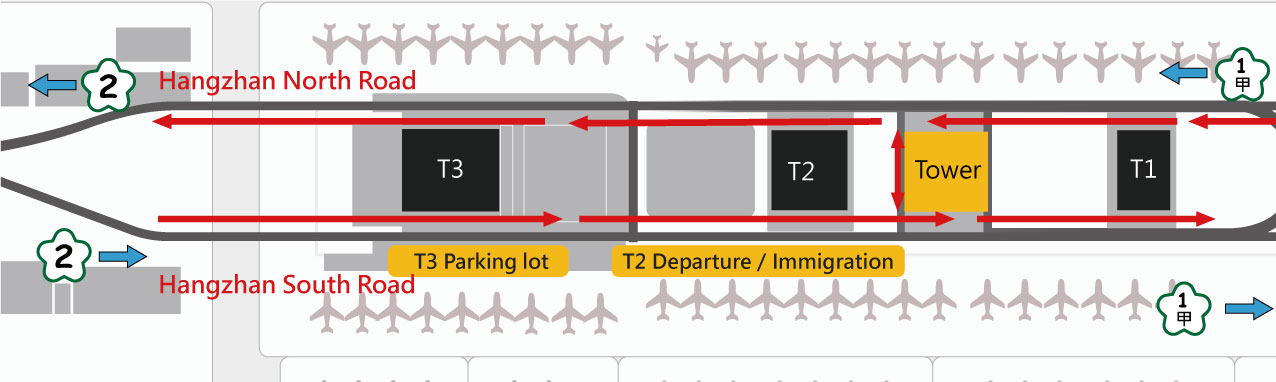
With the operation of the Airport MRT and T3, it is recommended to construct the underpass between the Hangzhan South Road and the Hangqin South Road to introduce an anti-clockwise circular access of the airport. The traffic flow is as indicated in the image.
CopyRight Taoyuan International Airport Co., Ltd.